

CDC ATSDR Region 9 Fellowship
To submit your application, scroll to the bottom of this opportunity and click APPLY.
A complete application consists of:
- An application
- Transcripts – Click here for detailed information about acceptable transcripts
- A current resume/CV, including academic history, employment history, relevant experiences, and publication list
- One educational or professional recommendation. Your application will be considered incomplete, and will not be reviewed until one recommendation is submitted.
All documents must be in English or include an official English translation.
Connect with ORISE...on the GO! Download the new ORISE GO mobile app in the Apple App Store or Google Play Store to help you stay engaged, connected, and informed during your ORISE experience and beyond!
*Applications will be reviewed on a rolling-basis.
CDC Office and Location: A research opportunity is available in the Centers for Disease Control and Prevention (CDC), Agency for Toxic Substances and Disease Registry (ATSDR), located in San Francisco, California. The fellow will likely be expected to travel for up to 10%, across the Pacific Southwest Region for site-related activities and to the ATSDR Atlanta headquarters office for training sessions and/or coordination meetings.
The Centers for Disease Control and Prevention (CDC) is one of the major operation components of the Department of Health and Human Services. CDC protects America from health, safety and security threats, both foreign and in the U.S. Whether diseases start at home or abroad, are chronic or acute, curable or preventable, human error or deliberate attack, CDC fights disease and supports communities and citizens to do the same. CDC increases the health security of our nation. As the nation’s health protection agency, CDC saves lives and protects people from health threats. To accomplish its mission, CDC conducts important science and provides health information that protects our nation against expensive and dangerous health threats, and responds when these arise.
The Agency for Toxic Substances and Disease Registry (ATSDR) is part of the Centers for Disease Control and Prevention, one of the major operation components of the Department of Health and Human Services. ATSDR protects communities from harmful health effects related to exposure to natural and human-made hazardous substances. ATSDR responds to environmental health emergencies, investigates emerging environmental health threats, conducts research on the health impacts of hazardous waste sites, and builds the capabilities of, and provides guidance to, state and local health agencies.
Research Project: You will gain experience with developing public health assessment reports evaluating community exposure pathways to chemical hazards. You will help in developing public health assessments that evaluate community exposure pathways to chemical hazards. You will have the opportunity to obtain experience and build on your academic training through assessment of regional environmental health issues at hazardous waste sites in rural communities and on Tribal lands, such as, but not limited to, Argonaut Mine NPL site, Copper Bluff Mine NPL site, and Lukachukai Mountain Mining District NPL site. You will also assess ATSDR petition sites such as VOC vapor intrusion or groundwater and drinking water concerns in southern California or in Guam.
Through this project, you will have the opportunity to learn ATSDR’s approach to conducting environmental public health assessments (details at https://www.atsdr.cdc.gov/pha-guidance/index.html). In collaboration with a multidisciplinary team of toxicologists, environmental health scientists, and epidemiologists at Region 9 and ATSDR headquarters, you will review the history and demographics of the site and surrounding area and analyze how it affects the risks and perceptions of the site. You will gather, organize, and analyze environmental sampling data; develop data visualizations; conduct exposure pathway analyses; and evaluate the public health implications of potential chemical exposures.
You will have the opportunity to participate in community outreach and stakeholder engagement events, conduct site visits, and develop notifications and communications to internal and external partners. You will learn new environmental public health tools and processes, be able to communicate with a variety of scientific and public health professionals and the public, will be able to research independently, and train as part of a multidisciplinary team.
Learning Objectives:
- Learn how environmental public health assessments are conducted to evaluate community exposure to chemical hazards.
- Gain experience assessing environmental health concerns at hazardous waste and Superfund (NPL) sites in rural communities and Tribal lands.
- Develop skills in analyzing environmental sampling data, exposure pathways, and potential public health impacts of chemical exposures.
- Learn ATSDR methods and frameworks for conducting environmental public health assessments and risk evaluations.
- Gain experience creating data visualizations and organizing environmental and demographic information to support public health analyses.
- Participate in multidisciplinary collaborations with toxicologists, environmental health scientists, and epidemiologists.
- Gain exposure to community outreach, stakeholder engagement, site visits, and public health communication activities.
- Develop professional skills in scientific communication, independent research, and multidisciplinary teamwork within environmental public health.
- You will learn new environmental public health tools and processes, learn to communicate with a variety of scientific and public health professionals and the public, learn to act independently, and be a part of a multidisciplinary team.
Mentor(s): The mentor for this opportunity is LaVedia Smith (zpn3@cdc.gov). If you have questions about the nature of the research please contact the mentor(s).
Anticipated Appointment Start Date: September 28, 2026. Start date is flexible and will depend on a variety of factors.
Appointment Length: The appointment will initially be for one year year, but may be renewed upon recommendation of CDC and is contingent on the availability of funds.
Level of Participation: The appointment is full time.
Participant Stipend: Stipend rates may vary based on numerous factors, including opportunity, location, education, and experience. If you are interviewed, you can inquire about the exact stipend rate at that time and if selected, your appointment offer will include the monthly stipend rate.
Citizenship Requirements: This opportunity is available to U.S. citizens only.
ORISE Information: This program, administered by ORAU through its contract with the U.S. Department of Energy (DOE) to manage the Oak Ridge Institute for Science and Education (ORISE), was established through an interagency agreement between DOE and CDC. Participants do not become employees of CDC, DOE or the program administrator, and there are no employment-related benefits. Proof of health insurance is required for participation in this program. Health insurance can be obtained through ORISE.
The successful applicant(s) will be required to comply with Environmental, Safety and Health (ES&H) requirements of the hosting facility, including but not limited to, COVID-19 requirements (e.g. facial covering, physical distancing, testing, vaccination).
Questions: Please visit our Program Website. After reading, if you have additional questions about the application process please email CDCrpp@orau.org and include the reference code for this opportunity.
The qualified candidate should have received or be currently pursuing a master's degree in one of the relevant fields (public health, environmental science, or related discipline).
Preferred skills:
- Strong written, verbal, and organizational skills.
I certify that I have not previously been employed by CDC or by a contractor working directly for CDC. I understand that CDC does not permit individuals with a prior employment relationship with CDC or its contractors to participate as trainees in the ORISE program. (Exceptions may be granted for individuals who, since the previous CDC employment, have obtained a new STEM degree which necessitates training in a new field.)

 ORISE GO
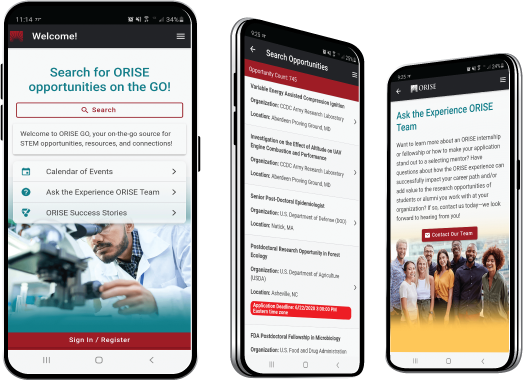
The ORISE GO mobile app helps you stay engaged, connected and informed during your ORISE experience – from application, to offer, through your appointment and even as an ORISE alum!